
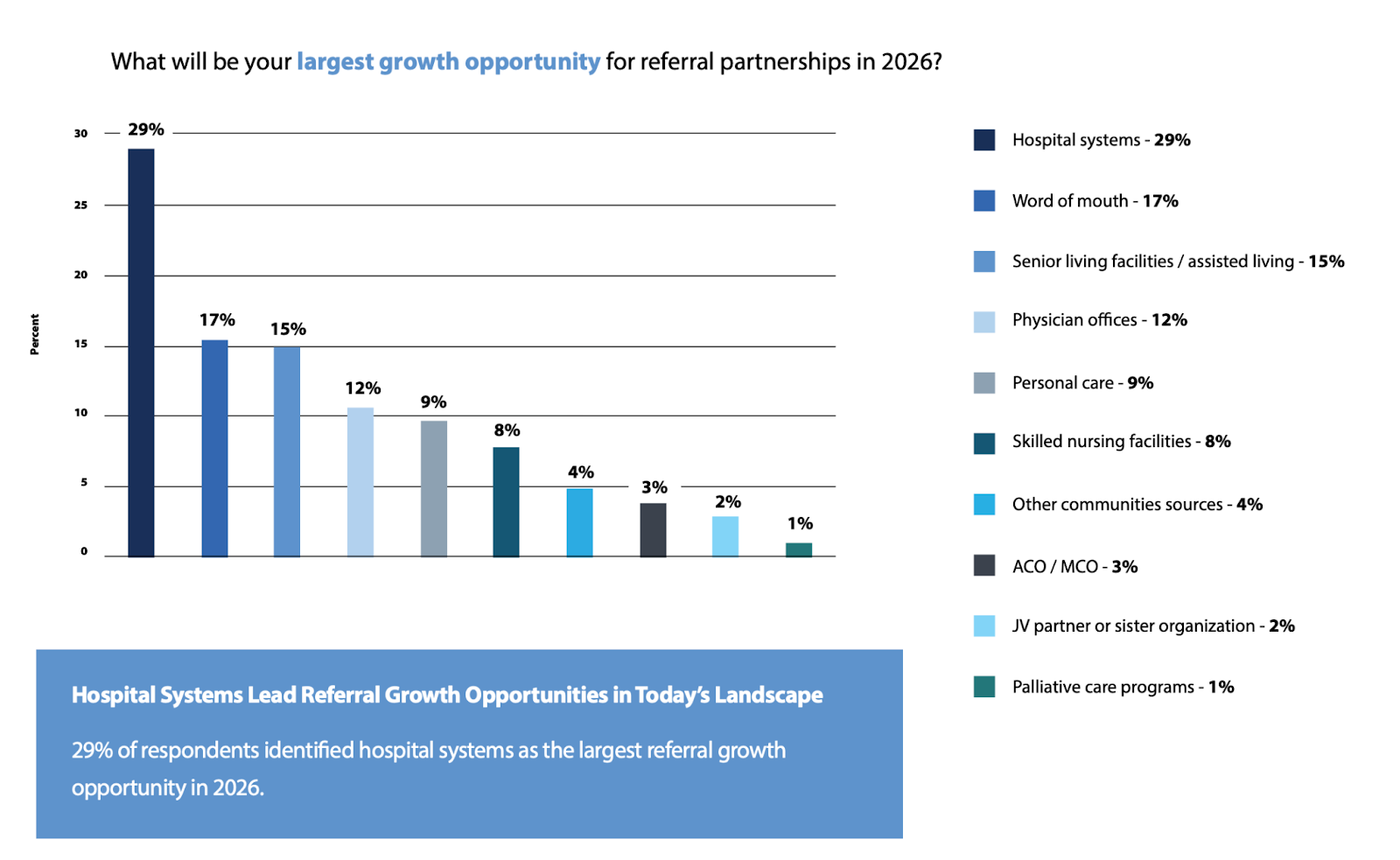
In 2026, home-based care providers have narrowed their focus to hospital systems as the top opportunity for referral growth.
The focus on hospital systems is a shift from years prior – a sharp shift since 2024, when home-based care providers identified hospitals and physician offices as the top opportunity, according to data from a new Home Health Care News report, sponsored by Homecare Homebase. The shift toward hospital systems is also a slight shift from 2025, when providers identified both hospital systems and assisted living as the top opportunity for referral growth.
“In 2026, hospital systems remain dominant, with word of mouth and senior living close behind,” the report read. “This trend indicates that upstream clinical alignment is now more valuable than downstream volume.”
The report is based on survey data from 103 professionals from home-based care organizations. Of the respondents, 64% identified as C-suite executives, owners, vice presidents and directors. The respondents included organizations of different sizes, with 53% of respondents’ organizations serving between one and 100 individuals daily.
On hospital systems’ end, getting patients into their homes as quickly as possible is a growing priority.
“That’s where they get to eat their own food, be with their pets, be with their family,” Lisa Musgrave, senior vice president of post-acute and at-home services at Ascension, previously told HHCN. “We’re working really hard at supporting understanding their goals, their caregiver situation, their home environment and what they need to get them to home as quickly as possible.”
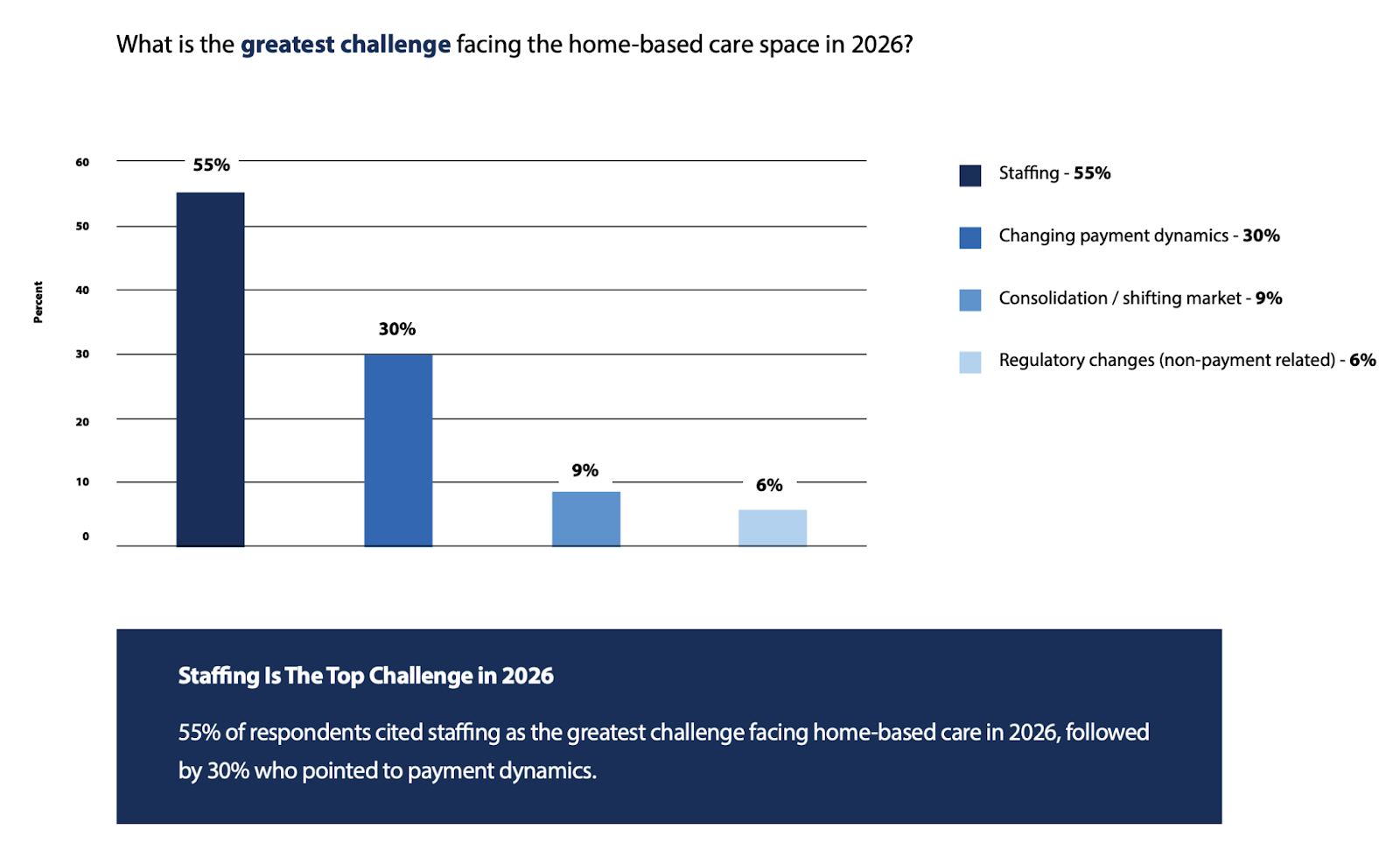
While crafting growth strategies, providers are still encountering persistent challenges. Top of mind in 2026 – as it was in 2024 and 2025 – is staffing. Over half of respondents identified staffing as the greatest challenge facing the home-based care space in 2026, demonstrating that staffing challenges have not gone away over the last few years.
There are signs that staffing challenges have stabilized, however.
“Staffing has ranked as the industry’s greatest challenge for three years running: 58% in 2024, 55% in 2025 and 55% again in 2026,” the report read. “The steady percentage suggests the crisis may be stabilizing, but it remains unsolved. As providers continue adapting, this signals long-term workforce planning, not short-term fixes.”
After staffing, changing payment dynamics was the second-most commonly identified challenge, followed by consolidation, market shifting and non-payment-related regulatory changes.
Payment and staffing hurdles often play into each other.
“Each year, our role becomes more critical as more individuals choose to recover at home – often discharged earlier and sicker than ever before,” Dave Totaro, former chief government affairs officer of Bayada Home Health Care and president and executive director of Hearts for Home Care, previously told HHCN. “Yet, CMS continues to undervalue this vital care by proposing reductions that threaten our ability to serve those most in need. These cuts exacerbate an already severe caregiver workforce crisis. … Talented professionals are being driven away from home health into hospitals and nursing facilities where pay is often higher, further weakening a system that depends on their dedication.”
Providers are leveraging technology, often AI, to address and overcome challenges. Most providers are still exploring these technologies, with 39% of respondents reporting that their organizations are exploring or evaluating potential tools. Still, almost a quarter have already implemented one or multiple AI tools.
For some providers, AI tools have become a daily aid, with 28% of respondents reporting that they use AI daily.
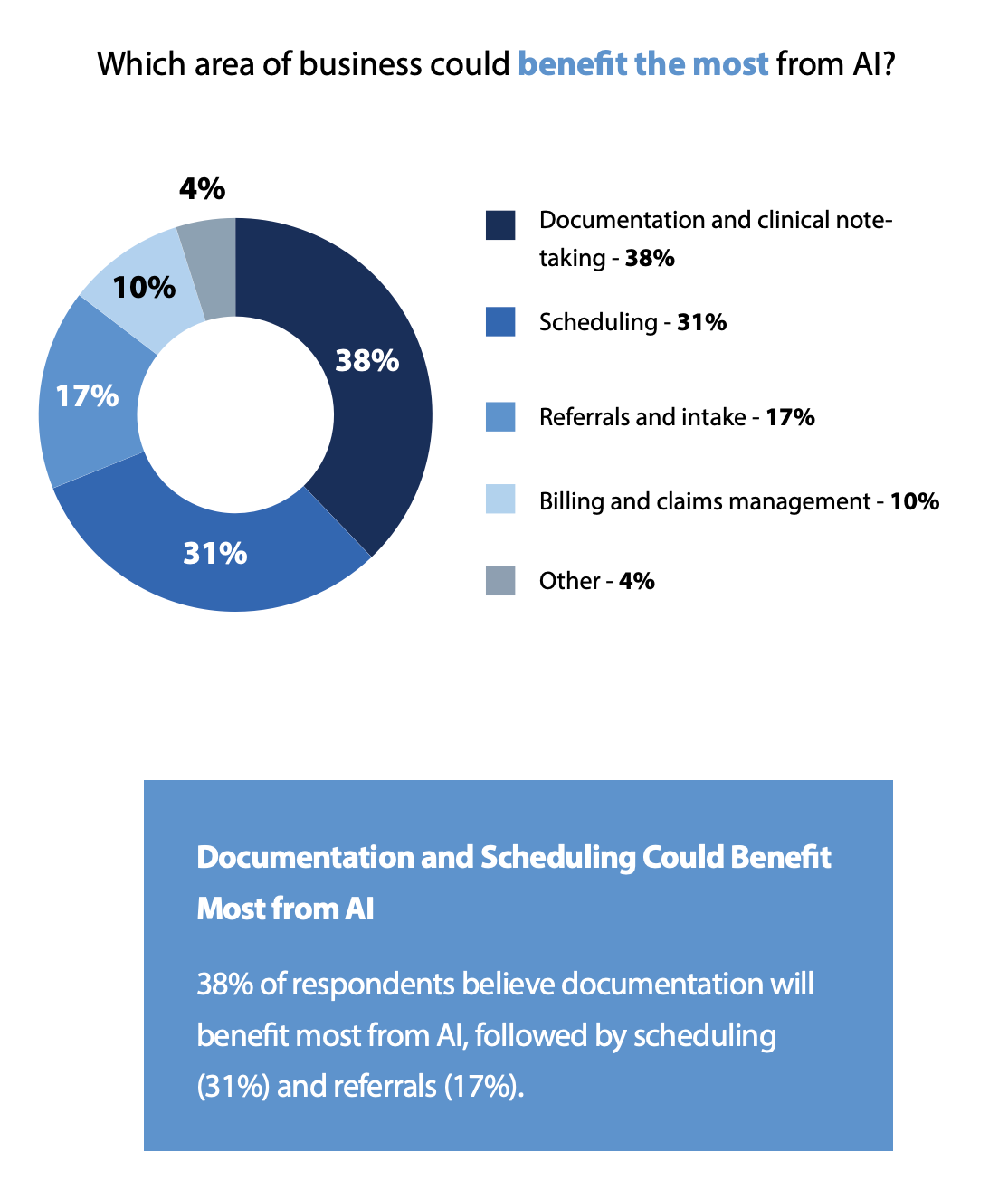
Documentation is a top target for AI-enablement, with 38% of respondents saying documentation was the part of their business that could most benefit from AI.
Technology tools, even those not AI-enabled, can relieve significant amounts of documentation processes for home-based care workers. For example, medication reconciliation can require 30 to 45 minutes of a clinician’s time, but technology that auto-populates a patient’s medications can reduce that figure to 10 or 15 minutes, according to Luke Rutledge, president of Homecare Homebase.
“That’s a huge win for the clinician, for the industry, for the patient,” Rutledge previously told HHCN. “It’s small things like that. We need to chase transcribing and [ambient] listening, but don’t overlook the real simple things that are already out there that can provide immediate value.”