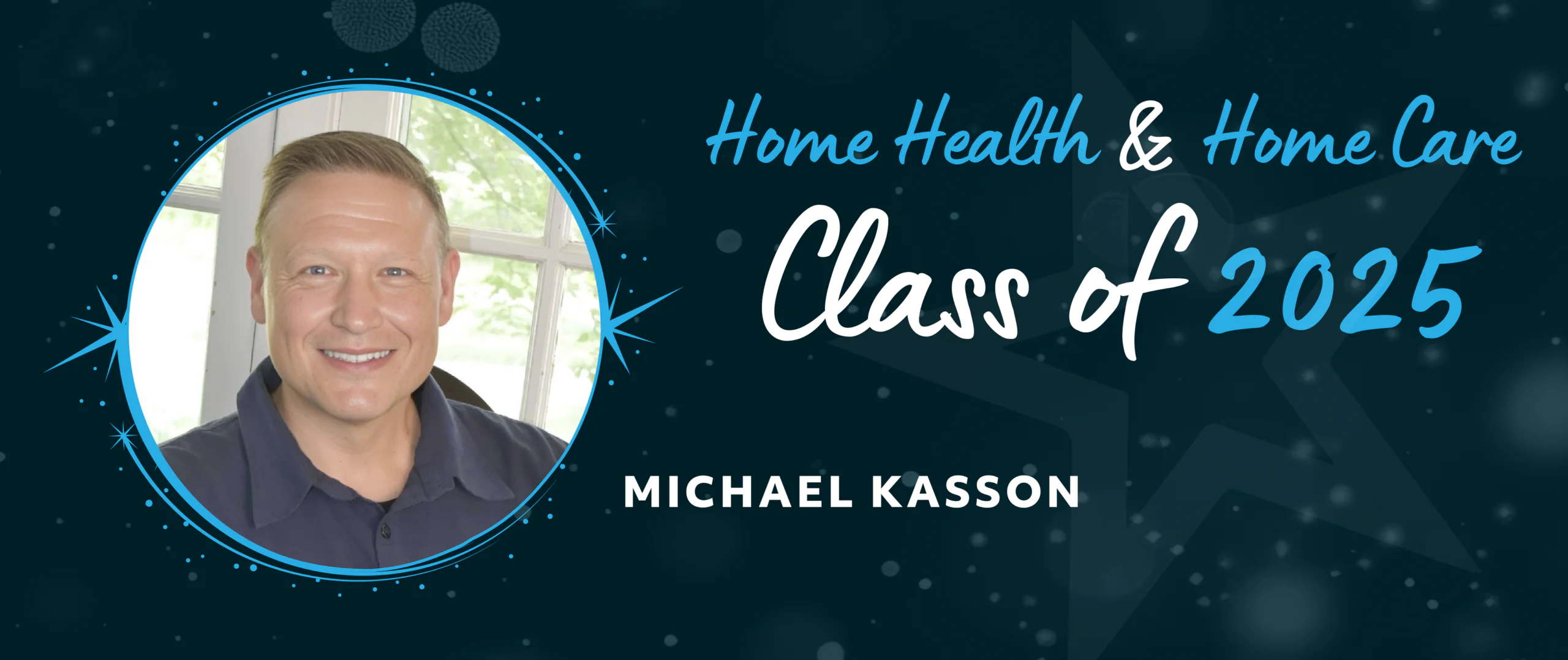
Michael Kasson, Administrator at Elara Caring, has been named to the Frontline Honors Awards Class of 2025 by Home Health Care News.
To become a Frontline honoree, an individual is nominated by their peers. The candidate must be:
- A dedicated, high-performing frontline worker who delivers exceptional experiences and outcomes
- A passionate worker who knows how to put their vision into for the good of their respective industry, the patients and residents they serve, and their families
- An advocate for their industry and their fellow colleagues
Home Health Care News recently caught up with Kasson to discuss her time in the home health & home care industry.
HHCN: What drew you to this industry?
Kasson: I was drawn to healthcare — and physical therapy specifically — because it allowed me to combine problem-solving with meaningful human connection. Over the years, working across acute care, outpatient, skilled nursing, and now home health, I’ve found that home health uniquely allows clinicians to meet patients where they are, literally and figuratively. Being invited into someone’s home creates an opportunity to provide care that is not only clinically effective, but deeply personal and impactful.
HHCN: What’s a misconception you had about this work before you started – and how has reality differed?
Kasson: Early in my career, I thought home health would be more limited clinically than other settings. In reality, it has been some of the most complex and rewarding work I’ve done. You’re managing patients with multiple comorbidities, limited resources, and real-world barriers — all while working independently. It requires strong clinical judgment, adaptability, and creativity, often at a higher level than more controlled environments.
HHCN: Was there a moment in your career when you realized, “This work really matters”? What happened?
Kasson: There have been many meaningful moments, but one that stands out was working with a patient who had not walked for many months. After consistent therapy and gradual progress, the day they took their first steps again, their entire family was present — and in tears. Seeing the relief, joy, and hope on their faces was incredibly powerful. At that moment, it was clear that this work isn’t just about mobility or clinical outcomes; it’s about restoring independence, dignity, and hope — not only for the patient, but for everyone who loves them.
HHCN: What’s the most valuable skill you’ve developed on the front lines that people often overlook?
Kasson: Clinical adaptability. Home health clinicians constantly assess, prioritize, and adjust plans of care in real time based on the patient’s environment, medical status, and psychosocial factors. That ability to think critically and make sound decisions independently is essential in home health, yet it’s often underestimated by those who haven’t done the work themselves.
HHCN: What’s one decision leaders make that has a bigger impact on frontline workers than they might realize?
Kasson: Workflow and documentation expectations. When leaders streamline processes and truly consider how much time clinicians spend charting versus caring for patients, it makes a tremendous difference. Efficient systems don’t just improve productivity — they reduce burnout and allow clinicians to focus on what matters most: patient care.
HHCN: What’s a simple change – policy, tool, or mindset – that would make frontline work more effective?
Kasson: Actively involving clinicians in decision-making makes frontline work more effective, and Elara Caring consistently demonstrates this commitment. By fostering a culture of respect, collaboration, and open communication, our leadership ensures that policies, scheduling, and tools reflect the realities of patient care. When clinicians feel supported and empowered, they are better able to deliver compassionate, high-quality care.
HHCN: What gives you optimism about the future of this industry, despite its challenges?
Kasson: The growing recognition of home-based care as a critical component of the health care continuum gives me optimism. As the population ages and health care continues shifting toward value-based models, home health is positioned to play an increasingly important role. I’m also encouraged by the dedication of frontline clinicians who continue to adapt, advocate for patients, and deliver high-quality care despite ongoing challenges.